What Is Intrinsic Value? A Plain-English Answer With Real Examples
What a business is really worth, how to estimate it in three steps, and two real 2026 examples from SEC filings: one that looks cheap and one that looks dear.
What is intrinsic value? It is what a business is really worth, based on the cash it will make in the future. The share price is what people pay for it today. The two are often different. When the price sits well below intrinsic value, the stock may be undervalued (cheap for what you get). When it sits well above, it may be overvalued. Nobody knows intrinsic value exactly, so a good estimate is always a range, not one number.
That is what intrinsic value means. The rest of this guide shows how to estimate it. You need no finance degree and no spreadsheet. We will do it step by step, with two real companies, using numbers from their own reports to the SEC (the US market regulator).
What is intrinsic value, in one picture
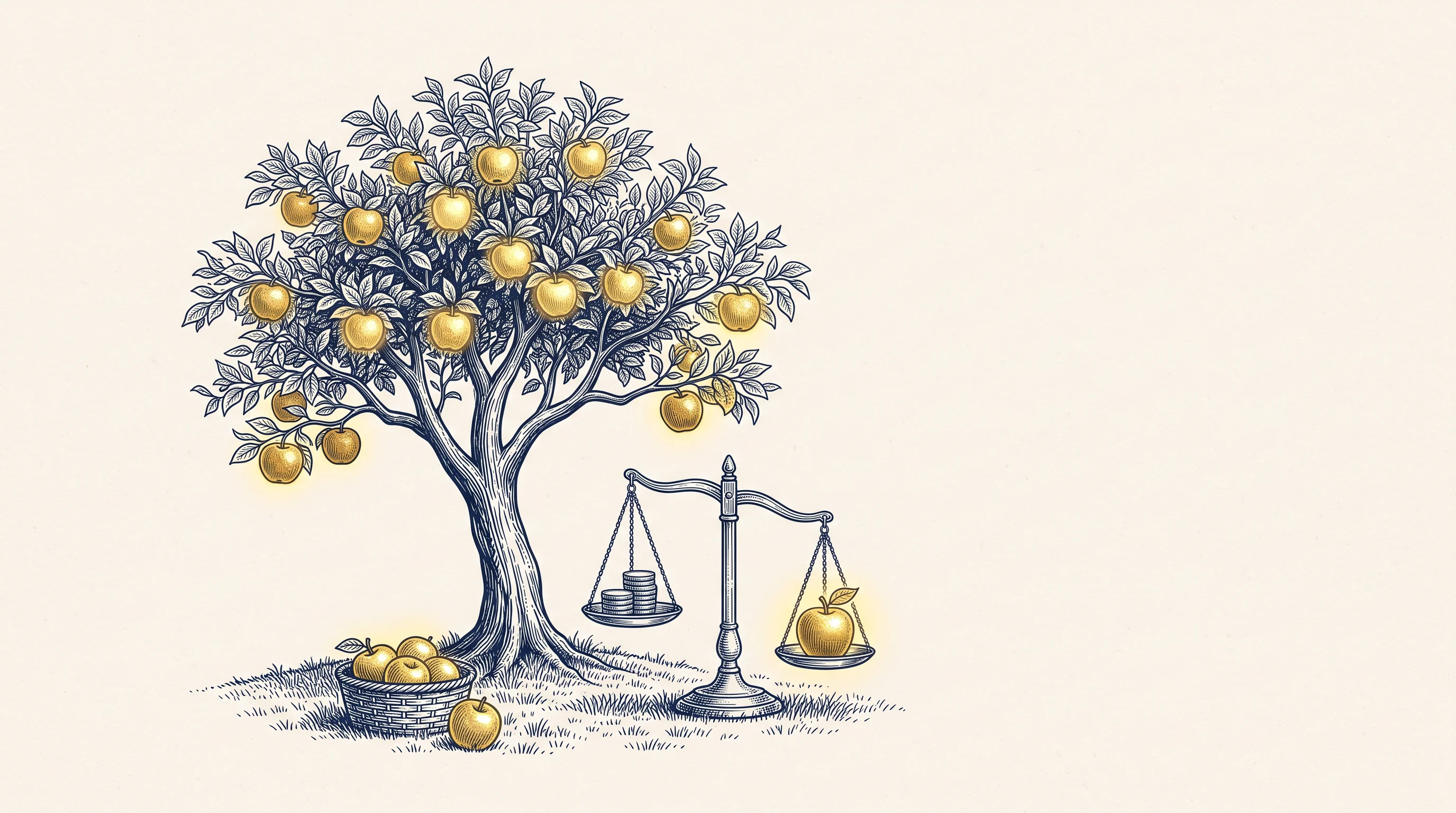
Think of an apple tree.
You can sell the tree today. Or you can keep it and sell its apples every year. A tree that gives $100 of apples a year for decades is worth a lot more than $100. But it is not worth "$100 times forever" either. Apples next year are worth a bit less than cash today. Apples in 30 years are worth much less. You also have to wait, and the tree might get sick.
So the tree's real worth is all its future apples, shrunk back to today's money. That is intrinsic value.
A company is the same tree. The apples are its spare cash. Warren Buffett, who ran Berkshire Hathaway for six decades, puts it in one sentence:
"Intrinsic value can be defined simply: It is the discounted value of the cash that can be taken out of a business during its remaining life."1
"Discounted" just means shrunk back to today's money. That is the whole idea.
Intrinsic value vs price
Price is set by buyers and sellers every second. It moves with news, fear and excitement. Intrinsic value moves slowly. It changes only when the business itself changes, or when interest rates move.
That gap is the whole game for a value investor. You look for good businesses whose price has fallen well below a careful estimate of their worth. The gap is your cushion if you are wrong. Investors call it a margin of safety.
A quick note on options
If you searched this word and found talk of "strike prices", that is a different meaning. In options trading (contracts that let you buy or sell a stock at a set price later), intrinsic value is just the gap between the stock price and the contract's price. This guide is about the first meaning: what a whole business is worth.
How to estimate intrinsic value in three steps
Professionals call this a discounted cash flow model, or DCF. The name is scary. The steps are not. Here is the simple version you can run in our free DCF calculator.
Step 1: Find the spare cash the business makes
Look at the company's annual report, called a 10-K. Find the cash flow statement. Take two lines:
- Cash from operations: the cash the business brought in from its normal work.
- Spending on equipment (often called "purchases of property and equipment"): the cash it had to put back in to keep going.
Cash from operations minus spending on equipment is free cash flow. It is the money the owners could take out without hurting the business. These are the apples.
We use cash, not profit. Profit can include items that never turn into cash. Cash is harder to dress up.
Step 2: Guess how fast that cash will grow
Nobody knows the future. So we keep the guess modest. In this guide we use the company's own sales growth over the last five years, capped at 10% a year. We assume that pace lasts five years. After that, we assume 2.5% a year forever, which is about the pace of inflation.
The cap matters. Great runs rarely last. A modest guess protects you from paying for a dream.
Step 3: Shrink future cash back to today's money
A dollar in five years is worth less than a dollar now. You could put today's dollar somewhere safe and earn interest. On 2 October 2026, the 10-year US government bond paid 5.28% a year.2 Stocks are riskier than that, so we ask for more.
We use three "required returns", also called discount rates: 9%, 10% and 11% a year. Each gives one answer. Together they give a range. A higher required return gives a lower value, because future cash counts for less.
Last, two clean-ups:
- Subtract debt, add spare cash. If the company owes money, the owners do not get that part.
- Divide by the number of shares. That gives intrinsic value per share, so you can compare it with the share price.
That is it. Three steps, two clean-ups.
Worked example 1: Adobe looks cheap by this test
Adobe makes Photoshop, Acrobat and other software. Here are its numbers from its latest annual report, for the year that ended 28 November 2025.3
| Item | Amount |
|---|---|
| Cash from operations | $10.03 billion |
| Spending on equipment | $0.18 billion |
| Free cash flow | $9.85 billion |
| Sales, 2020 → 2025 | $12.87B → $23.77B (about 13% a year) |
| Growth we assume | 10% a year (the cap) for 5 years, then 2.5% |
| Cash minus debt | +$1.6 billion (more cash than debt) |
| Shares | 389.2 million |
| Share price, 5 Oct 2026 | $238.79 |
Now the three steps at a 10% required return. Adobe's spare cash grows from $9.85 billion to about $15.9 billion over five years. Each year's cash, shrunk back to today, is worth about $9.85 billion. Five years of it add up to about $49 billion in today's money.
Then comes everything after year five. Growing at 2.5% forever, it is worth about $217 billion in year five. Shrunk back to today, that is about $135 billion.
Add it up: $49B + $135B + $1.6B spare cash = about $185 billion. Divide by 389.2 million shares. You get about $477 a share.
Do the same at 9% and 11%, and the range is:
| Required return | Intrinsic value per share |
|---|---|
| 9% | $552 |
| 10% | $477 |
| 11% | $419 |
The price was $238.79. That is about half the middle estimate. By this simple test, Adobe looks cheap.
So why is the price so low? The market is not stupid. Many investors worry that new AI image tools will take Adobe's customers. If that happens, its cash could shrink instead of grow. We can test that worry. Our free checker asks what growth today's price assumes, over 10 years. It starts from Adobe's last 12 months of spare cash: $10.6 billion, to 28 August 2026. At a 10% required return, the price makes sense only if that cash shrinks about 3.7% a year for 10 years. Yet its sales grew about 13% a year over the past five years. That is the bet the market is making. Intrinsic value does not tell you who is right. It tells you exactly what you would need to believe.
Adobe is on our list of undervalued US stocks tonight. You can see its full numbers on the Adobe stock page. This is not advice.
Worked example 2: Apple looks expensive by the same test
Apple's latest annual report covers the year that ended 27 September 2025.4
| Item | Amount |
|---|---|
| Cash from operations | $111.48 billion |
| Spending on equipment | $12.72 billion |
| Free cash flow | $98.77 billion |
| Growth we assume | about 8.7% a year (its 5-year sales growth) for 5 years, then 2.5% |
| Debt minus cash | $42.8 billion |
| Shares | 14.59 billion |
| Share price, 5 Oct 2026 | $332.89 |
Run the same three steps and you get:
| Required return | Intrinsic value per share |
|---|---|
| 9% | $136 |
| 10% | $117 |
| 11% | $102 |
The price was nearly three times the middle estimate. By this simple test, Apple looks expensive.
Again, ask what the price needs you to believe. Our checker starts from Apple's last 12 months of spare cash: $136.7 billion, to 27 June 2026. At $332.89, the price makes sense only if that cash grows about 15.7% a year for 10 years. Its sales grew about 8.7% a year over the past five years. Over the last five reported full years, its spare cash grew from $73 billion to $99 billion. That is about 6% a year.
Is Apple a bad company? No. It is one of the best businesses in the world. Buyers are betting it stays great for far longer than five years, which this guide's short model does not count. That is the honest weakness of any simple model. But it also shows the risk: you are paying today for a lot of good news that has not happened yet.
Why intrinsic value is a range, not one number
Look at the two examples again. Moving the required return by one point shifts Adobe's value by $60 to $75 a share. A different growth guess would move it more.
Buffett says the same thing about his own company:
"Intrinsic value is an estimate rather than a precise figure, and it is additionally an estimate that must be changed if interest rates move or forecasts of future cash flows are revised."1
So treat any single number with suspicion. A sensible use of intrinsic value looks like this:
- Price far below the whole range (like Adobe): worth a closer look. Then ask why the market is worried.
- Price inside the range: about fair. No bargain, no alarm.
- Price far above the whole range (like Apple): you are paying for a lot of growth. Ask if you really believe it.
Common mistakes beginners make
1. Using profit instead of cash. Profit can include one-off gains and paper items. Cash is what owners can actually take out.
2. Guessing growth too high. A company that grew 30% last year rarely keeps it up. If your estimate needs a dream to work, it is not an estimate.
3. Forgetting the debt. A company worth $100 billion that owes $40 billion is worth $60 billion to its owners.
4. Trusting one number. Always run a low, middle and high case. If the stock only looks cheap in the rosiest case, it is not cheap.
5. Using it on banks and insurers. Their "cash flow" works differently, because money is their raw material. The same method gives nonsense for them. Our checker says so in one sentence instead of making up a number.
6. Forgetting that the business can change. Intrinsic value is only as good as your guess about the future. Read the company's own report. Our guide on how to read a 10-K shows where to look.
Is intrinsic value the same as book value or market value?
No. They are three different things.
- Market value is the share price times the number of shares. It is what the market pays today.
- Book value is what the company's accounts say it owns, minus what it owes. It looks backward, at what things cost.
- Intrinsic value looks forward, at the cash the business will make.
A software company can have a small book value and a huge intrinsic value, because its worth is in its products and customers, not its buildings.
Try it on any stock
You now know more about intrinsic value than most people who quote the term. Here is how to use it without doing the maths by hand:
- Quick answer: type a ticker into the free Is it undervalued? checker. You get our verdict, the growth today's price assumes, and the company's past sales growth.
- Your own guesses: open the DCF calculator. Change the growth and required return and watch the value move.
- A ready-made shortlist: our undervalued US stocks list is rebuilt every night from SEC filings. It shows only companies that pass our quality and price tests. New to this? Answer 3 questions and see up to three companies that fit you.
The checker starts from the latest 12 months of cash, not the last full year. For Apple that is $136.7 billion, not the $98.8 billion above. So its answers can differ a lot from this guide's tables. Prices move every day too.
Related reading
For a deeper look at the cash-flow method, see our DCF valuation guide. For a simpler first pass on price, read what is a good P/E ratio. For a broader method with three ways to value a company, see how to value a stock for beginners. And to turn the gap between price and value into a rule, read the margin of safety formula.
More plain-English guides are in the Hub.
This article is for education only. It is not advice to buy or sell any stock.
Berkshire Hathaway, Owner's Manual, section on intrinsic value. ↩ ↩
Federal Reserve Bank of St. Louis, 10-Year Treasury Constant Maturity Rate (DGS10), value for 2 October 2026. ↩
Adobe Inc., Form 10-K for the fiscal year ended 28 November 2025, cash flow statement. Revenue history, cash, debt and share count from Adobe's SEC XBRL filings; price is the 5 October 2026 close. ↩
Apple Inc., Form 10-K for the fiscal year ended 27 September 2025, cash flow statement. Revenue history, cash, debt and share count from Apple's SEC XBRL filings; price is the 5 October 2026 close. ↩